CBAM – A New Tool for Sustainable Value Chains
What used to be a loophole is now a liability: Carbon costs follow the product, no matter where it's made. One of the most transformative initiatives today is the EU’s Carbon Border Adjustment Mechanism (CBAM), a climate policy tool designed to put a price on carbon emissions from imported goods. CBAM is not just a technical adjustment, it represents a paradigm shift that fundamentally affects business strategies, supplier relationships, and sustainability efforts.
CBAM – what is it and why does it matter?
CBAM (Carbon Border Adjustment Mechanism) = An EU rule that makes companies pay for the carbon emissions of certain goods produced outside the EU. It helps stop companies from moving production to countries with weaker climate rules, and ensures fair competition.
CBAM is the EU’s response to the issue of carbon leakage – where companies relocate production to countries with weaker climate regulations to avoid costs. For example, a company that manufactures steel-based products might consider relocating its factory outside the European Union to avoid carbon taxation. By requiring importers to pay for the emissions generated during the production of certain goods outside the EU, CBAM creates fairer competition between European and foreign producers.
Starting January 1, 2026, CBAM will apply to goods such as
- steel,
- aluminum,
- cement,
- fertilizers,
- electricity, and
- hydrogen.
Importers will be required to purchase CBAM certificates equivalent to the emissions associated with the production of these goods.
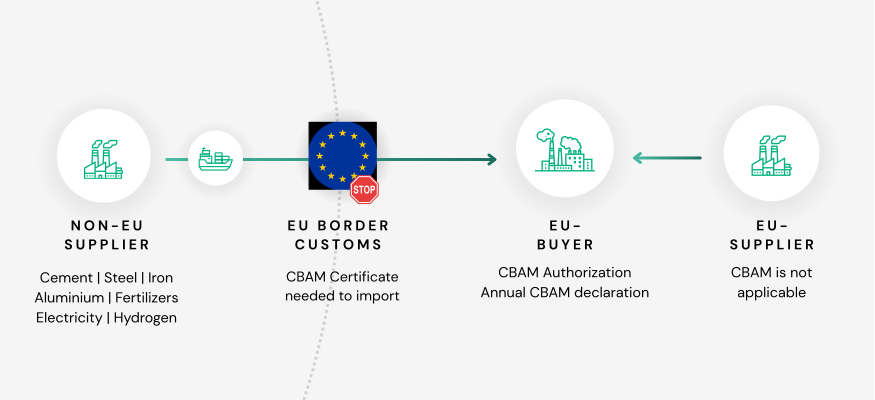
CBAM reports obligation for companies during the transition phase to the end of 2025
- Quarterly CBAM reports shall include:
- Quantity of imported goods
- Embedded emissions (direct and indirect)
- Carbon price paid in the country of origin
Under the EU’s simplified CBAM regulation (EU) 2025/2083, companies must report in the CBAM registry when purchasing CBAM-covered goods that exceed the previous exemption threshold of €150 per consignment, as defined in Article 23 of Council Regulation (EC) No 1186/2009.
CBAM reports obligation for companies after the definitive phase from 1st of January 2026
- Submit annual CBAM declaration by 30 September of the following year, first time 2027 for year 2026.
- Purchase and surrender CBAM certificates equal to embedded emissions.
- New de minimis threshold: Importers with ≤ 50 tonnes/year of CBAM goods are exempt from reporting and certificate obligations
CBAM vs. EU ETS – How they relate
The EU ETS (Emissions Trading System) is an internal carbon pricing mechanism for companies operating within the EU. It requires sectors like steel, cement, and aluminum to buy allowances covering their CO₂ emissions produced in the EU.
The CBAM (Carbon Border Adjustment Mechanism) works on the same principle but applies to imports from outside the EU. It ensures that foreign producers face the same carbon cost as EU-based companies, preventing carbon leakage, when production moves to countries with weaker climate regulations to avoid carbon costs.
In simple terms:
-
ETS = pay for carbon emissions on goods produced within the EU
-
CBAM = pay for carbon emissions on goods imported into the EU
Opportunities and challenges for companies
CBAM presents both opportunities and challenges. For companies already actively engaged in climate work, CBAM can become a competitive advantage. Demonstrating control over emissions, even upstream, can strengthen brand reputation and build trust with customers and investors.
At the same time, CBAM introduces new requirements for reporting, traceability, and verification. Companies must be able to show how much carbon is embedded in their imported goods and have systems in place to collect and report this data. For small and medium-sized enterprises, this can be particularly challenging, although the EU has introduced certain simplifications, such as exemptions for import volumes under 50 tons per year.
Strategic recommendations
To meet CBAM requirements and simultaneously create business value, I recommend that companies:
- Map emissions across the entire value chain, including upstream suppliers.
- Implement systems for data collection and reporting, preferably supported by digital tools.
- Educate suppliers on CBAM and sustainability requirements.
- Conduct simulations of CBAM costs to understand business impact.
- Seek strategic advice on CBAM certificates, payments, and risk management.
CBAM in a Global Context
CBAM also has geopolitical implications. Countries like India, China, and the United States have expressed concerns that CBAM could affect trade relations and create new barriers. At the same time, negotiations are underway to include national carbon pricing systems in CBAM, which could reduce double taxation and promote international cooperation.
Companies can look at CBAM as a reporting burden – or a driver for change. For companies aiming to lead in sustainability, CBAM offers an opportunity to demonstrate accountability, strengthen competitiveness, and contribute to a fairer and more climate-friendly global trade system.
If you’re curious about how CBAM affects your company, we are happy to help. Book a meeting with one of our experts.