EFRAG has published the simplified ESRS drafts

EFRAG has published the simplified ESRS drafts that were approved by the sustainability reporting board (EFRAG SRB) on 28 November 2025. In these simplified drafts the mandatory data points have been decreased by 61%. Our expert Susanna Kiviniemi attended the event where the simplified standards were announced. Here’s an overview of the biggest, most visible changes that have been made.
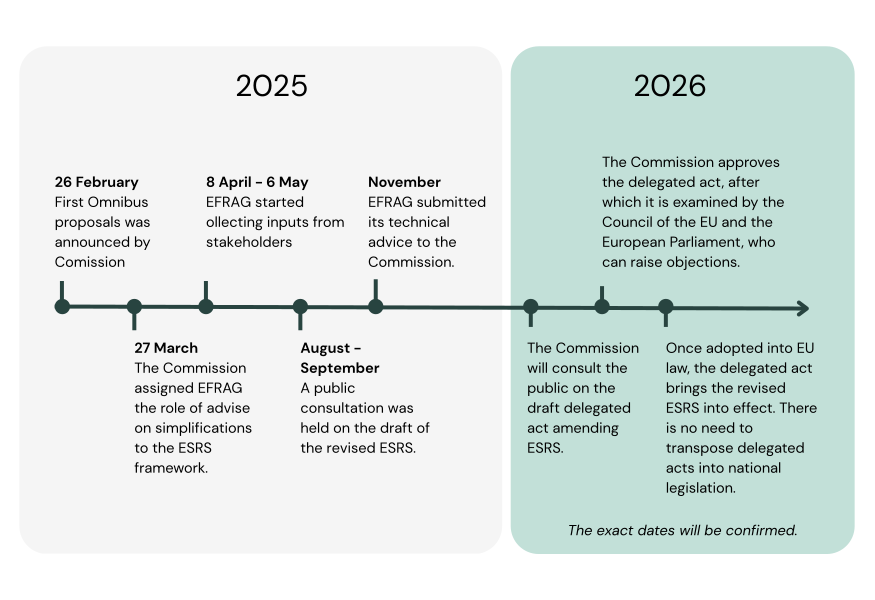
Structure of the standards
- Structure of the standards is clarified to eliminate repetition in the standard and later in the report. This has resulted in reorganizing Minimum disclosure requirements (MDRs) and Policies, Actions and Targets (PATs) that are renamed General disclosure requirements (GDRs) and presented in ESRS 2.
Materiality assessment
- Top down-approach preferred in the materiality assessment. No need to look into IRO’s for all the topics that are considered immaterial on topical level. Companies are still allowed to use the bottom-up-approach if they find it more suitable for their purposes.
- Clarified the practices of how positive and negative impacts, risks and opportunities should be handled (No net approach, so positive impacts do not offset the negative impacts. Also, it is clarified that the results of prevention, mitigation or remediation actions to address negative impacts the undertaking is connected to, or compliance with law and regulation, are not positive impact.
- Lighter financial materiality
Horizontal simplification of topical standards
- Quantitative data was cut less than the narrative data
- No new obligations were encouraged, but eventually new datapoints were created to clarify what data must be reported on.
- Specifications of geography have been removed from elsewhere than biodiversity. Own consideration if that is needed.
- Pressure to get direct information from the value chain actors is relieved by eliminating the preference of direct data overestimates
- Voluntary datapoints are removed and new non-mandatory guidance will be made separately. (These guidelines are currently under development by EFRAG.)
Environment
- For the environmental standards, the metrics have been kept but simplified.
- Interoperability between many standards such as GHG, GRI and TNFD has been strengthened.
- Some eliminations such as secondary microplastics are not to be reported since no reliable data is available.
- For E5 one new datapoint has been created to serve simplification: designation of waste unknown.
- A Climate transition plan is not required but if one is not made, then companies have to disclose that they do not have one in place and indicate whether and, if so, when they expect to adopt one.
- GHG financial control: Reporting is done for the companies within the financial control so that it is aligned with the reporting boundaries for financial reporting.
- A climate related risks scenario analysis is not required but it will improve the quality of the report.
- Quantitative information related to Substances of concern (E2) is a phase-in requirement that will be mandatory only in 2030.
Social
- Human rights policy moved to ESRS 2. Significant datapoint reduction, including the deletion of S1-1 Health and safety policy as an explicit requirement
- The simplification introduces new definition of human rights incidents: substantiated, limited to internationally recognised human rights, and assessment based on severity of impacts
- The concept of materiality consideration for non-employees is introduced.
- Gender pay gap has to be presented in an unadjusted way, but the standard allows also to present the gender pay gap in entity specific adjusted way.
Governance
- This has been least controversial and burdensome.
- Removal of granular datapoints and focus on supplier relationships, corruption and bribery and whistleblowing.
Lastly
- Implementation guidance will be published in 2026.
- Message “Do not wait, even if there are transition periods, because these are complex topics. This will increase your resilience”.
- Standards are a living beast. The Commission shall consult a number of parties, such as ESMA, EBA, EIOPA, and national technical experts, so changes may occur.
- These simplified ESRS draft standards can be used for the preparation of 2026 reporting but with reservations.
- EU will publish a delegated act based on VSME for companies that are not within the CSRD scope but above 250 employees. Commission will start working on that in a couple of months.
EFRAG published a knowledge Hub for the ESRS’s and Q&A which makes navigating the standard much easier.
Recommendation for reporting companies
The objective is for the revised standards to apply from FY2027, with a possibility for earlier application for FY2026 (still to be confirmed).
- Wave 1 companies:
- FY2025: either voluntary reporting under CSRD, or continuing to report under NFRD provisions (as also explicitly suggested by the CSSF), including compliance with the EU Taxonomy Regulation
- For FY 2026: compliance with the initial set of ESRS and “quick fix” amendments,
- Wave 2 companies:
- Scope to be confirmed based on Omnibus*
- First reporting expected in FY2027 under the new ESRS
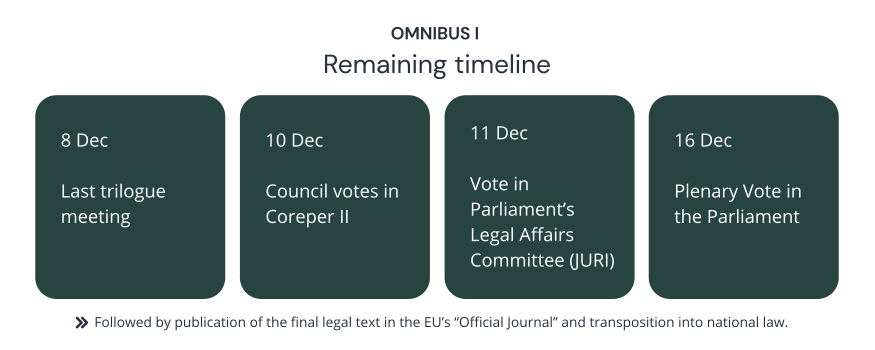
*Omnibus I final triloque is scheduled for this week. The agreement on CSRD is expected to be reached before the end of the year.
Sources
- EFRAG provides its technical advice on draft simplified ESRS to the European Commission | EFRAG
- Simplified ESRS Factsheets
- Event: EFRAG unveils Draft Simplified ESRS: A European Milestone for Sustainability Reporting